

"The Drama"

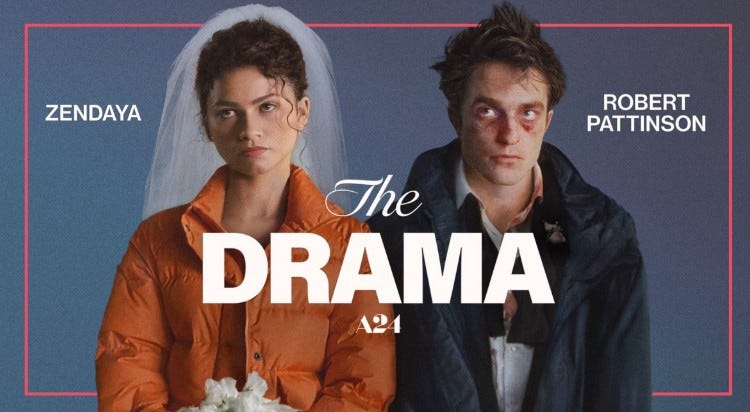
Among eternal human truths -- sorry, Nietzsche -- is that all people are stuck in a values-laden world. Humankind loves their moralities, especially the kind of morality that traps and ensnares others. An abider can thereby feel superior to violators.
The advanced romcom “The Drama,” released in theaters in April 2026, rests on this assumption.
As a wedding movie, it specifically claims that if your spouse-to-be has strongly considered doing a dirty something in his or her dark past, that would not only bother you, it might threaten the relationship’s future, mainly because it might imperil your status with others.
So goes the modern vanity on display in this movie, whose trailer and poster advertising make it look like a casual romantic night at the movies. It is not close to that at all.
“The Drama” examines and blisters neurotic partners, who also trade in hypocrisy, but not knowingly to them, because they live life with a great many unexamined assumptions.
I suggest not reading anything more about this movie’s plot revelations. The main plot problem relies on a revelation that has weightier impact when the viewer does not know what’s coming.
So I won’t say what that revelation is; I’ll just talk around it.
“The Drama” signals early on that it could be a romcom. The Meet Cute hits hard and fast, just two minutes in, when Charlie (Robert Pattinson) approaches Emma (Zendaya) in a café. To ask her out, he feigns knowledge of the book she’s reading. This white lie seems innocent, yet its transgression ought to be remembered for the remainder of the film.
Quickly, via montage, these two Jane-Austen-named lovers in modern-day Boston become engaged. Their wedding-day approaches soon. One night, with this couple out with another couple — the man- and maid-of-honor — in a tipsy moment, the four of them trade a personal secret: they reveal the worst thing that each of them has done.
It’s a contrived scene, but necessarily so, because the build-up is towards what Emma has to say.
That’s the revelation that should not be spoiled, occurring around the film’s 22-minute mark. It floors Charlie, and it offends the maid-of-honor, who has an emotional eruption about it.
Charlie spirals. What is his bride-to-be really? A psychopath? He’s in the classic setup of many a noir and horror movie: what if his hot fiancée is a real monster?
And then you look at Zendaya, who plays well off the reliable Robert Pattinson, and you ask how could she be a monster?
Besides, what she did happened back when she was probably about 14 years old. At 30, surely she’s a completely different person?
Charlie’s neurosis is that of a number of any of this movie’s upper-crust characters, urban American millennial types. Yet with a British accent, Pattinson plays him with a whiff of Gen-X Brit romcom phenom, Hugh Grant, and the ultimate Boomer neurotic, Woody Allen. Charlie’s hallucinations about what Emma tried to do are shown for us, as we enter into his dark moral fantasies about who Emma might really be. Allen’s various male-lover characters have had an infinite number of those.
This all is played, surprisingly, as dark humor. I laughed a lot in the first half, because the movie has fun blistering likeable people who probably ought to study philosophy or wisdom literature.
In fact, “The Drama” plays close to the classic Idiot Plot, where one word of revelation would make the plot machinations stop, yet nobody utters the word. All it should take, from my point-of-view, is one moment of forgiveness from Charlie. He hesitates, and can’t get there, because what Emma told him about her 14-year-old self bothers him too much.
None of the characters in the movie, especially Charlie, seem to have any moral frameworks for forgiveness, confession, or guilt. They feel guilt or condemnation without knowing why, without also reflecting on their own actions and standards as opposed to the moral pressures they put on Emma. What the bride has done might be serious and scarring, and yet how her wedding party reacts is hypocritical and infuriating.
Also, Emma’s “worst action” is one that probably a few people will in fact deal with. It represents a more general problem, that of teenage desires and actions following a person around during the digital age.
It should be said that Charlie and Emma’s wedding day is soon, real soon, and of course a movie like this has a contract with its audience: we will get the wedding, revelations will occur, stupidities will occur during the wedding ceremony or afterparty, and it will be funny only because it just might happen to any one of us.
I appreciated the first half of the movie immensely, and director Kristoffer Borgli has a sharp sense of how to poke fun at male characters. His weirdo 2023 science-fiction movie with Nicolas Cage, “Dream Scenario,” had its moments.
This one does too, yet the movie spin its wheels, plot-wise, by the middle of Act 2. It ends in such a way that I can imagine a lot of you will be annoyed with it.
One of its larger problems is its avoidance of family and social life beyond the four main characters. Where are their families, counselors, therapists, doctors, or advisors of any kind? In a classic Boomer movie of this type, the couple would certainly go to marriage counseling. A cornball scene of silly dialogue would follow.
Yet neither Charlie nor Emma consult their mothers, siblings, or therapists about their relationship problems. The parents of Charlie and Emma barely make an appearance.
I cannot tell if that’s a descriptive feature, a diagnosis of the relative isolation of these modern American singles, or whether it’s a convenience for the movie to not have to add in other actors. Realistically, and in terms of the movie tradition of this kind of film, it makes little sense to me.
That goes to a giant critical question I had about “The Drama,” which is perhaps the most important critical question for stories in any medium: how much the movie is describing reality as it is, and how much is it engaging in a movie fantasy?
It’s hard to pull off a realistic wedding movie, in terms of filmic realism, since the traditional style of this fare is romantic Hollywood classicism (e.g., “Father of the Bride”) -- e.g., exaggeration and hyperbole of every major plot problem, telegraphed jokes, and syrupy reaffirmations of basic societal values.
I just can’t tell where “The Drama” ends up. It’s hard to be satirical and syrupy simultaneously, but I think that’s where it ends up.
Addendum: a clever movie deserves a clever, unique title. As title, “The Drama” is the antithesis of clever. For whatever reasons, several recent A24 movies have had lame titles: “Friendship,” '“Opus,” The Moment,” “Eternity,” “Bring Her Back,” “Warfare.” They need help.